

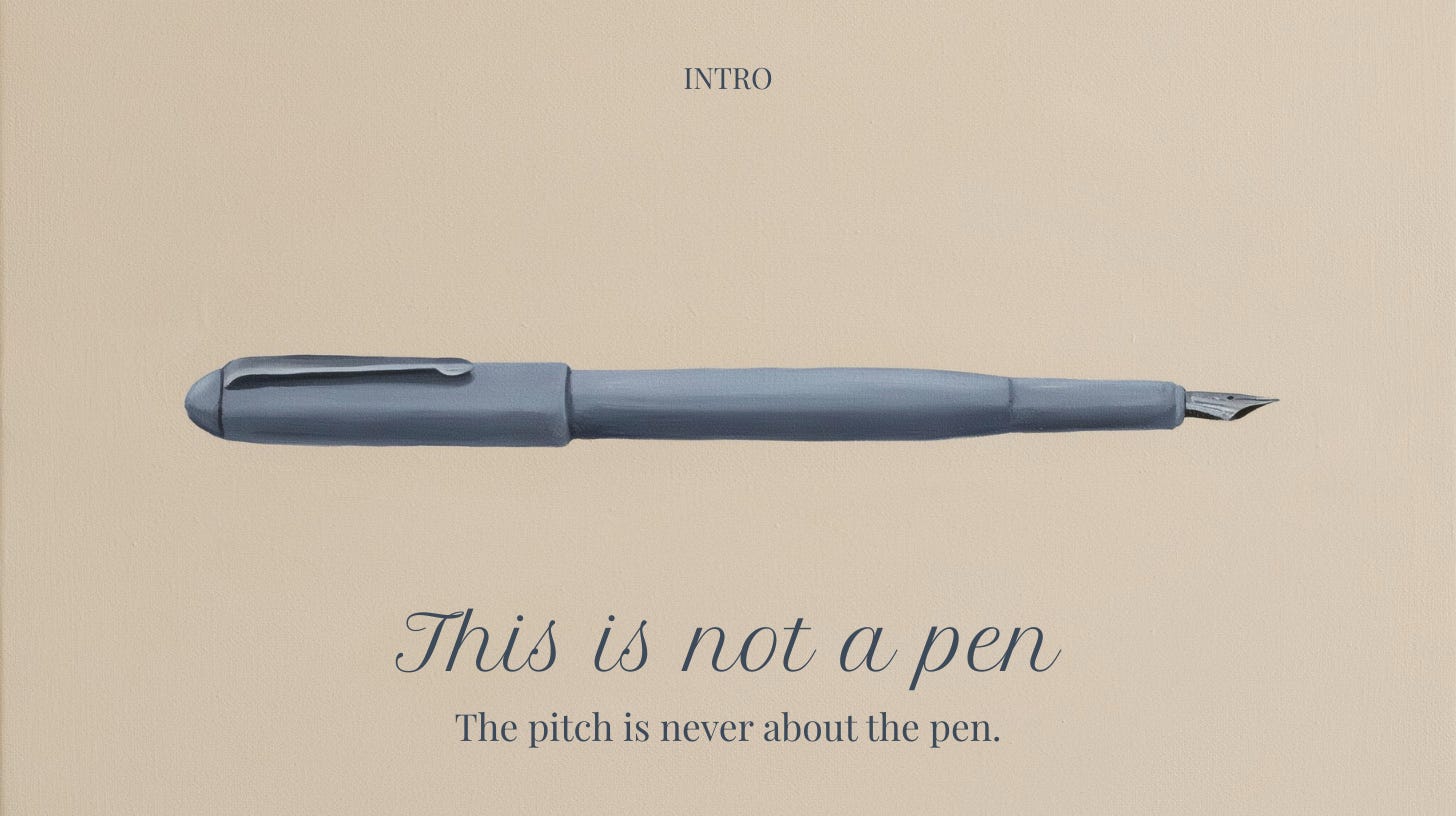
“Sell me this pen”
I figure that this will be your litmus test.
If you have a salesperson in front of you, you expect them to start with the pitch.
So, how to crack this?
I could do the working man salesman pitch - “look at all my achievements, trust me, I know what I’m doing!”.
Or, I could also do something more sophisticated.
I could list the possible reasons for you to be here and build from there:
You don’t have a credible forecast (or don’t even have one)
You can’t increase sales
You want to hire a sales manager, but your lack of knowledge distorts your judgement
… and so forth
The truth is that both approaches would work (at smaller and bigger degrees).
The thing about sales is that trust is its currency. So, listing credible prior achievements and/or talking about your pain points before you relate them to me are good ways to develop trust, since it signals expertise - “I know you, or at least somebody like you”.
But before we get into that, let’s step back a little.
Do you see what I am doing? Or better, what I’ve just done?
You are still reading this, and I haven’t pitched.
I didn’t try to sell the pen.
So, let me give you a first insight about sales: if you can’t close, you should be at least advancing.
The promise
In a typical sales process, you’d start with discovery.
You’d start by asking some questions to understand your prospect better, see if it matches your product, and do a soft pitch - this is how you’d see if the opportunity is good to look at or not.
In this case, you can’t talk back to me, so here’s how I’m selling you my pen, a capella:
I will teach you how to set up a sales machine - the processes that will allow you to generate leads, close them, and forecast your business in a scalable manner.
And how do I know that this is a good sales pitch?
Most companies don’t have a sales system. They have a salesperson. And if you are still here, reading about sales and sales systems, you're very likely to be in that demographic.
Chapters in a book
My Substack will explain to you how to tell the man from the system, and how to build the real thing.
Understand each article as a chapter that builds into this big idea of a sales machine.
These chapters will be organised to support one of five ideas that I believe are key for you to understand sales systems completely.
The ideas are as follows:
You (probably) don’t have a sales system
For you to have one, everyone needs to speak the same language
You need to set up the sales machine before feeding it (or supercharge it)
There’s a person to run that machine, and it is not you
CRO is the endgame (and no — that’s not a hamburger)
I’m going to explain all of the above. One idea at a time.
Now, for the finale
Who am I to say all of this with such confidence?
I’ve done some interesting things regarding sales machines, multiple times and in different shapes.
For example, at Motofil, I built the company’s first cloud CRM from scratch — no template, no consultant, no prior system to copy. I designed the sales process with the team, implemented the tooling, and ran the pre-sales function simultaneously. Conversion went up 30%.
At AGT Robotics, I inherited a European operation that was almost entirely dependent on one market. I built the rest of it — 16 agents across 16 countries, the first SDR function, the first regional marketing hire, first machines placed in 7 new markets. We more than tripled sales in two years - a new company record.
None of it came with a manual.
I started to work in sales because my Master’s in Economics was at night and I needed a job to have money.
When I started, I had no references, either inside the company or outside.
It was tough, but it was also a blessing in disguise.
With no one to help me and no recipes, I had to build my own cookbook - read the books, find the people, have the conversations, test things, reason from first principles… It forced me to build a framework, a way to interpret the sales function, instead of following instructions.
This is what I want to relay to you: how to see sales systems, so that you don’t need to follow recipes.
That means that this Substack is for someone who wants to be a chef, not a cook.
So, think of me not as a Master, but as a Guide — somebody who is just a bit further down the path.
Welcome to the kitchen.